

IC Case with MagSafe Price in Bangladesh


IC Case with MagSafe for iPhone: What Bangladeshi Buyers Actually Need to Know Before Ordering
If you’ve searched for a MagSafe case in Bangladesh recently, you’ve probably noticed something odd: almost every store lists the “MagSafe” word, but almost none of them explain the one thing that actually separates a real MagSafe experience from a case that just happens to hold a magnet. That missing piece is the IC chip — and it’s the difference between your case snapping into place with a satisfying click, showing up correctly when you place it on a charger, and a case that magnetically clings on but never truly “talks” to your iPhone the way an Apple-made case does.
This guide covers what an IC case actually is, how to tell a genuine one from a copy before you pay for it, and what to check so you don’t end up with a case that blocks your wireless charging instead of improving it — something none of the local product pages currently walk you through in any real detail.
What “IC” Actually Means in a MagSafe Case
Every iPhone from the 12 onward has a ring of magnets built around its wireless charging coil, plus a small NFC reader sitting right next to it. That NFC reader is what lets your iPhone recognize an official MagSafe accessory — it’s why Apple’s own cases trigger a colour-matched animation on your lock screen the moment you snap them on, and why Find My can identify certain MagSafe accessories by name.
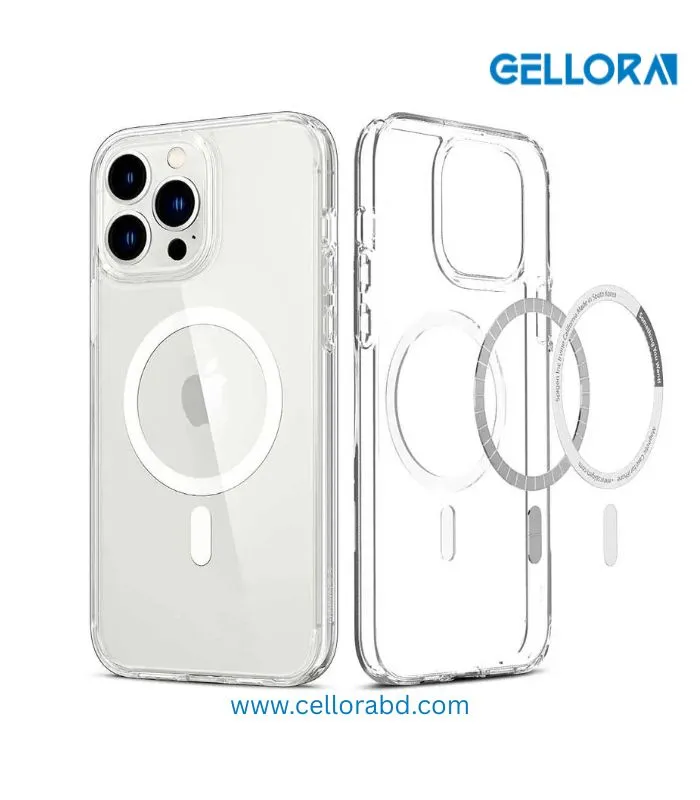
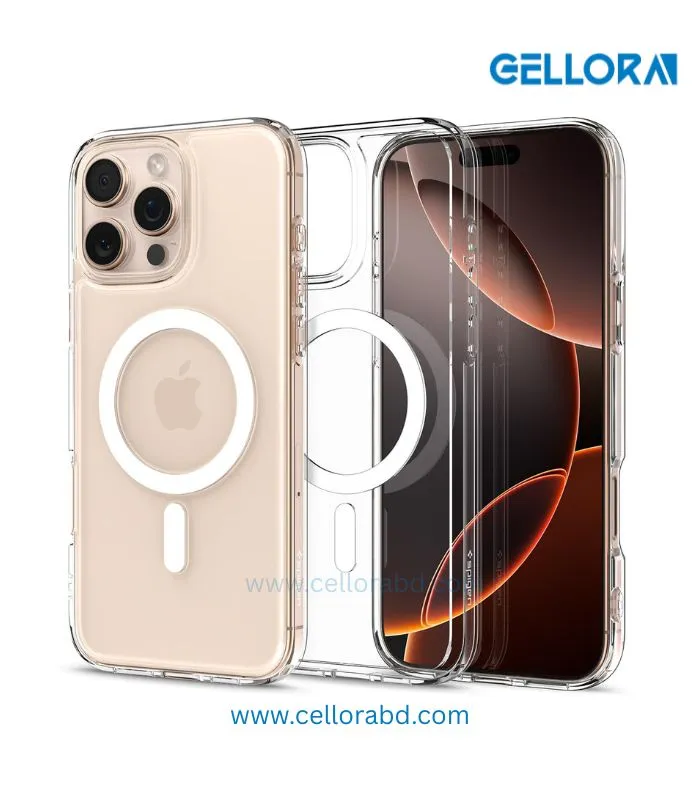
An “IC case” — sometimes listed as an IC Cover in local shops — is a third-party case built with that same recognition chip embedded near the magnet ring. The chip itself doesn’t move any power — it’s purely a communication component that lets the iPhone confirm the case is present and aligned correctly. A case without this chip can still hold magnetically (most “magnetic cases” sold cheaply do), but your phone has no way of confirming the connection is a true MagSafe fit. In practice, this shows up as weaker snap alignment, inconsistent charging speed on MagSafe chargers, and no recognition animation — small things individually, but they add up to a noticeably less reliable daily experience.
This distinction matters more in Bangladesh than in most markets, because the local market is flooded with cases labelled “MagSafe” that are really just standard cases with a metal ring glued inside for basic magnet pull. None of the major Bangladeshi retailers currently explain this difference on their product pages — they use “MagSafe Supported” and “Magnetic” interchangeably, which leaves buyers with no way to judge what they’re actually paying for.
Why Most Bangladeshi Sellers Skip This Explanation
Looking at how local competitors structure their listings, the pattern is consistent: a product title built around “Price in Bangladesh,” a short paragraph about scratch and drop protection, a bullet list of generic features like anti-yellowing and dust resistance, and a delivery/warranty block repeated word-for-word across dozens of unrelated products. It’s built for a quick sale, not for a buyer trying to understand what they’re actually getting.
That’s a real gap, and it’s one you can close simply by being straightforward about the difference between an IC-chip case and a basic magnetic case. Buyers who’ve already been burned once — bought an IC Case with MagSafe or a “MagSafe” case that didn’t charge properly or fell off a car mount — are actively searching for this explanation, and right now nobody in the local market is giving it to them clearly.
How to Check If a Case Has a Real IC Chip Before You Buy
- Ask the seller directly whether the case includes an NFC/IC chip, not just magnets. A seller who understands their own product will answer this without hesitation; one reselling unbranded stock usually won’t know.
- Look for the recognition animation. When a genuine IC case is placed on the iPhone, a colour-matched ripple or accessory name typically appears briefly on the lock screen. If a listing shows unboxing footage, this is one of the easiest things to verify on video before you order.
- Check the stated magnet count and layout, not just “magnetic.” Apple’s array uses a precise ring of over a dozen small magnets positioned around the coil. Cheaper alternatives often use two to four larger magnets in a rough circle, which explains why some cases feel like they hold on stronger initially but drift out of alignment during charging.
- Confirm wireless charging wattage. A properly built IC case shouldn’t drop your charging speed below 15W on a genuine MagSafe charger. If a product page can’t or won’t confirm charging speed, that’s usually because it hasn’t been tested against one.
- Match the case to your exact model, not just the series. iPhone 15 Pro and 15 Pro Max have different camera bump dimensions from the standard 15 and 15 Plus, and a case built for the wrong variant shifts the magnet ring just enough to weaken the connection — even if the case “fits” physically.
Material and Build Differences That Actually Affect MagSafe Performance
Not every material interacts with MagSafe the same way, and this is another area local listings gloss over:
- Clear TPU/PC cases are the most common option in Bangladesh and generally perform well with MagSafe as long as the magnet ring sits close enough to the surface. The trade-off is that cheaper clear cases yellow within a few months of regular sun exposure, which is common with Dhaka’s climate and daily commuting.
- Silicone cases offer better grip and drop resistance but slightly reduce magnetic pull strength because the material sits marginally thicker around the ring. A well-built IC case compensates for this with stronger internal magnets.
- Leather and leather-style cases tend to have the most consistent MagSafe alignment because they’re usually built thinner around the coil area, but they show wear faster in humid conditions.
- Cases with a metal or carbon-fiber-look back plate should be checked carefully — metal components positioned too close to the coil can interfere with both the NFC chip and the wireless charging signal itself, regardless of how strong the magnets feel.
What This Means for Buyers Comparing Prices
Local pricing for IC Case with MagSafe-labelled cases in Bangladesh currently spans a wide range — inexpensive clear cases sit well under a thousand taka, while cases from official Apple resellers can run into several thousand. That gap isn’t only about branding. A large part of it comes down to whether the case includes a genuine IC chip, uses a properly spaced magnet array, and has been tested against an actual MagSafe charger rather than just a generic wireless pad. A buyer comparing two similarly priced “MagSafe” cases has almost no way to tell them apart from the product page alone — which is exactly the information gap worth filling with a direct, honest comparison rather than another repeated spec list.
IC Case Price in Bangladesh by iPhone Series
Since IC Case with MagSafe chip placement and magnet spacing change slightly with every redesign, pricing and fit aren’t identical across generations. Here’s how it breaks down series by series, which is worth knowing before you compare an IC Case Price in Bangladesh listing against an IC Cover Price in Bangladesh listing that looks cheaper at first glance:
- IC Case for iPhone 12 Series — the 12, 12 mini, 12 Pro, and 12 Pro Max share the same magnet ring position, so cases are cross-compatible across the series. Because this is the oldest MagSafe generation, genuine IC covers here are usually the most affordable in the local market, though stock is thinner than for newer models.
- IC Case for iPhone 13 Series — nearly identical internal layout to the 12 series but with a slightly larger camera bump on the Pro models, so a 12-series case will not sit flush. Buy per-model rather than assuming series-wide fit.
- IC Case for iPhone 14 Series — the 14 Plus introduced a larger body than any case built for the standard 14, so always check the exact model name, not just “14 Series,” when comparing an IC Case Price in BD | iPhone listing.
- IC Case for iPhone 15 Series — this generation moved to USB-C and adjusted the internal frame slightly, which shifted magnet tolerances just enough that older cases marketed as “universal MagSafe” often sit slightly off-centre on the 15 Pro and 15 Pro Max.
- IC Case for iPhone 16 Series — camera module size increased again on the Pro models, so cutout precision matters more here than on any previous generation; a misaligned cutout is the most common complaint on this series specifically.
- IC Case for iPhone 17 Series — the newest generation, and currently the most limited in local stock. Expect IC Cover Price in BD | iPhone listings for this series to sit higher simply because supply hasn’t caught up with demand yet, not because the case itself is more complex to build.
Across all series, the price gap between a basic magnetic case and a genuine IC Case with MagSafe typically comes down to three things: whether the chip is real, whether the magnet count matches Apple’s spacing, and whether the cutouts are tooled for the exact model rather than the whole series. That’s the context missing from almost every current IC Case Price in Bangladesh listing — most just state a number next to a model name with no explanation of what’s driving the difference.
Common Questions Bangladeshi Buyers Are Actually Asking
Does an IC case work if my iPhone doesn’t have a case already installed on a MagSafe charger? Yes — an IC case is designed to be used on the phone at all times; it doesn’t replace or interfere with the phone’s own MagSafe system, it extends it while adding protection.
Will a cheaper magnetic case damage my iPhone if it’s not a true IC case? It won’t damage the phone directly, but poorly placed magnets can interfere with the compass and, in rare low-quality cases, sit close enough to affect charging coil alignment, leading to slower or inconsistent wireless charging.
Can I tell the difference just by holding the case? Not reliably. Strength of the initial magnetic snap is a poor indicator — some counterfeit cases use stronger raw magnets to compensate for lacking the actual IC chip, which can feel convincing in-store but doesn’t translate to correct charging alignment.
Does the IC chip wear out over time? No, the chip itself has no moving parts and doesn’t degrade with use. What does wear down is the case material around it, which is why checking build quality matters as much as the chip itself.
The Bottom Line
The real gap in Bangladesh’s MagSafe case market isn’t product selection — it’s clarity. Buyers are choosing between cases that look identical on a product page but perform very differently in daily use, and no one selling them locally is explaining why. Being the store that actually breaks down what an IC chip does, how to verify one before buying, and how material choice affects real-world MagSafe performance isn’t just better content — it’s the kind of practical, specific information that search engines and buyers both reward, because it answers the question people are actually typing into Google before they ever add something to their cart.


















I am using this IC cover, a really good phone cover. 100% recommended.